
English| EUR
Suggested for you
More currencies
Choose a language
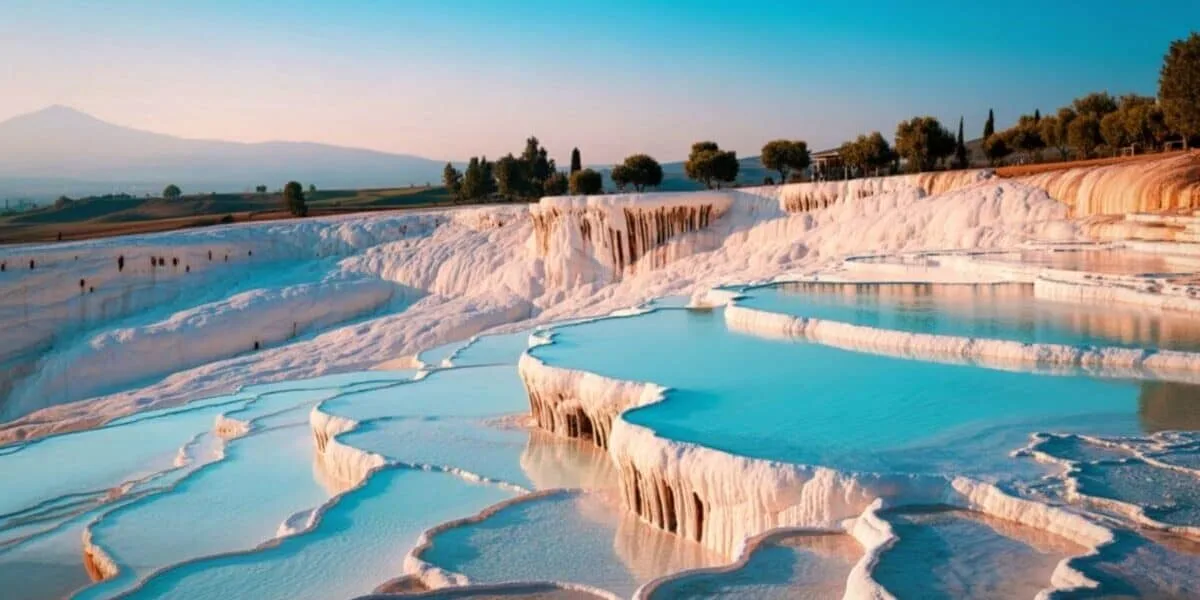
Pamukkale's white calcite terraces and the ancient ruins of Hierapolis lie 210 kilometers northeast of Marmaris, a journey that crosses the coastal mountains and climbs into the Denizli plateau. The question of distance matters less than the reality of the route: no direct highway links the two, and the journey requires planning around terrain, transfer points, and the conservation site's early opening window.
Quick answer
Pamukkale sits 210 kilometers from Marmaris by road, a journey that typically takes 3 to 3.5 hours depending on the route and traffic through Denizli province. Most travelers follow the D330 highway northeast through Muğla, then connect to the inland route via Denizli city, where the road climbs from sea level to the plateau at 1,000 meters elevation. Private transfers and organized tours cover the distance in a single morning departure, while public buses require a transfer in Denizli's central bus terminal.
The 210-kilometer separation between Marmaris and Pamukkale represents more than a simple distance figure — it marks the boundary between two distinct geographic zones, the Aegean coast and the interior Anatolian plateau. The coastal resort town sits at sea level along the Mediterranean, while the travertine terraces occupy a plateau edge in Denizli province, 1,000 meters above sea level and 70 kilometers inland from the nearest coastal point. No direct highway bridges the two; instead, the D330 arcs northeast through the Muğla mountains before turning inland toward Denizli city, where travelers connect to the final leg toward Pamukkale village. The journey from Marmaris to Pamukkale follows a route shaped by topography. The first half climbs through forested mountain passes, winding along ridgelines where the road surface narrows and curves tighten. After crossing into Denizli province, the route descends onto agricultural plains before the final ascent to the plateau where Hierapolis and the calcium-carbonate formations sit. The 3 to 3.5-hour travel time reflects not just the 210-kilometer span but the elevation gain, the road geometry, and the bottleneck through Denizli's outskirts, where regional traffic converges. Understanding the Marmaris-Pamukkale distance informs every other logistical decision. A day trip from the coast requires a pre-dawn departure to reach the terraces during the optimal 06:30 to 10:00 arrival window, when the thermal pools reflect morning light and coach groups have not yet arrived from inland cities. Organized tours from Marmaris bundle the transfer with a guided circuit of Hierapolis' Roman theater, necropolis, and the Antique Pool, returning travelers to the coast by evening. Independent travelers using the public Denizli bus connection gain flexibility in timing but add 45 minutes to the total journey and navigate the transfer at the otogar terminal. The 210-kilometer route also dictates what to carry. The plateau climate runs 5 to 8 degrees Celsius cooler than the coast, and the travertine surface becomes hot underfoot by midday, making early starts essential. Travelers departing Marmaris at 06:00 reach the terraces by 09:30, allowing two hours to walk the calcite pools barefoot, explore the archaeological zone, and return to the parking area before the afternoon heat peaks. The conservation fee of 30 EUR per person covers both Pamukkale and Hierapolis, and no separate ticket is sold for the terraces alone, a detail that shapes budgeting for travelers weighing the distance against the cost.
“The 210-kilometer span between coast and plateau crosses two climate zones, an elevation gain of 1,000 meters, and a bottleneck through Denizli's outskirts where regional traffic converges.”
Pamukkale is located approximately 240 kilometers northeast of Marmaris. The most efficient way to travel between these two locations is via the D330 and D585 highways, which connect the coastal region to the interior of Denizli province.
D330 and D585 highways
Direct bus from Marmaris Otogar
D330 and D585 highways
Arriving by private car allows for direct access to the designated parking areas near the site entrance. For those using bus services, local dolmuş shuttles provide regular connections from the Denizli city center to the Pamukkale entrance.
The best arrival window is 06:30–10:00 to avoid peak heat and afternoon bus tour crowds arriving from coastal regions like Marmaris. Planning your visit during these morning hours ensures a more manageable experience at the site.
Mild, 18°C–25°C. Ideal for walking the travertine terraces comfortably.
Pleasant, 20°C–27°C. Lower humidity makes the long journey from Marmaris more tolerable.
Hot, 30°C–35°C. Early arrival is essential to avoid peak afternoon temperatures.
—
Arriving at 06:30 provides the quietest experience before large excursion groups reach the site.
Verdict: The best time to visit is during spring or autumn on a weekday, arriving at the 06:30 opening time to bypass the main influx of daily visitors.
Pamukkale is open daily to visitors throughout the week. Planning your visit according to these hours helps coordinate your logistics from Marmaris.
This plan suits travelers making the full-day journey from Marmaris, balancing early departure with meaningful time at the site. Expect roughly twelve hours total, with around three hours on-site.
Leave early to cover the ~240 km drive and arrive during the cooler morning window. The journey takes approximately three to three-and-a-half hours.
Reach Pamukkale during the recommended arrival window, purchase your ticket, and head straight for the terraces before the heat builds.
Remove shoes and walk the brilliant white calcium pools from bottom to top; allow forty-five minutes to take it slowly and photograph without rush.
Wander the ancient city above the terraces—theatre, necropolis, and colonnaded streets—spending roughly ninety minutes among the Roman remains.
Eat at a nearby restaurant in Pamukkale village, then rest briefly before the return drive.
Set off for the three-to-three-and-a-half-hour journey back, arriving by early evening.
A long day trip from Marmaris requires thoughtful preparation to stay comfortable across the journey and thermal terraces.
Everything you need to know about how far is pamukkale from marmaris
The distance between these two locations is approximately 200 to 210 km. Many visitors find that understanding how far is pamukkale from marmaris helps in planning their travel logistics.
Travel time typically ranges from 3 to 4 hours by coach. Knowing how far is pamukkale from marmaris allows you to prepare for a full-day excursion that usually spans 10 to 12 hours including transport.
Yes, organized bus trips are a popular way to travel between these cities. These tours simplify the logistics of how far is pamukkale from marmaris by providing direct hotel pick-ups and drop-offs.
The best arrival window is 06:30–10:00 to avoid peak heat and afternoon crowds. This is a common question when researching how far is pamukkale from marmaris, as early departures are necessary for the long journey.
Yes, the entry fee covers both the thermal terraces and the ancient city of Hierapolis. These sites are situated together at the same location, making them ideal for a single visit.
You should bring comfortable shoes, a swimsuit, a towel, sunscreen, a hat, and your passport. Preparing these items ensures you are ready for the thermal pools and archaeological ruins upon arrival.
The entrance fee is 30 EUR per person, which is a conservation fee that includes access to both Pamukkale and Hierapolis. This fee is standard for all visitors entering the site.
The journey is generally considered child-friendly, although it involves a long bus ride that may be tiring for very young children. Families should plan accordingly for the total travel time from the coast to the interior.